
Beowulf: A Preview and Reading Schedule
Hwaet! A new season of APS Together


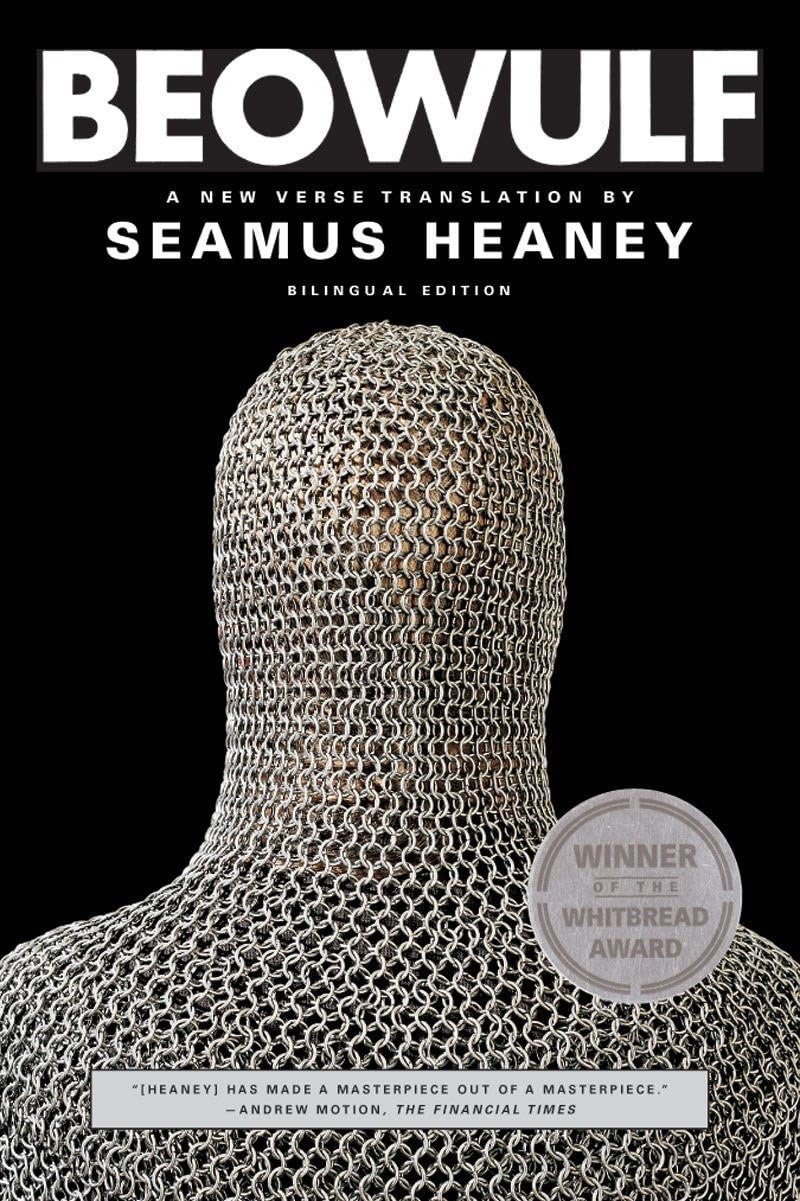
A new year! A new season of APS Together! Join us starting Tuesday, January 20 to read Seamus Heaney's translation from the Old English of the great epic Beowulf, together with longtime A Public Space friend and contributor Robert Sullivan. Hwaet! Off we go.
A Note From Robert Sullivan
The end of a year feels epic. So too the view from New Year’s Day to the months ahead. Is there a better time to turn to an ancient poem? To look back as we chart our courses forward, open new daybooks and behold as our Google calendars populate? In interviews and introductions, Seamus Heaney admitted a kind of regret in taking on the task of translating Beowulf, which, in the moment of his editors’ proposal, seemed doable, then, as one decade passed, then two, a hard row—“scriptorium slow,” he reported. Relief arrived when he saw a relationship between words in the poem and those in the land he grew up in; it was his key, a poetic security clearance. The gorgeously drawn, rhythmic lines that Heaney finally published at the opening of the twenty-first century feel as much like a poem as a vessel, a wave-carried craft with which we explore territories that are defined by uses, by strategies, by hopes and fear. See that advantageous prominence! Beware the moor swamped by dread in a landscape where threats deemed existential really are. Between kingdoms and seas, the destinies of individuals (“unknowable yet certain”) weave together like the gold-thread tapestries that fuel wars and warriors. Set your keel. Rig your mast with its sea-shawl and join us as we translate for ourselves an epic translation.
A Note on APS Together
APS Together is a communal-reading series from A Public Space. Join us to read together—daily, imaginatively, miscellaneously. Each session is hosted by a friend of A Public Space, who selects and introduces a book to read together; and shares notes every morning, with fellow readers joining in. At the end of each book, we gather (usually online) for a finale conversation with our APS Together host and A Public Space editor Brigid Hughes.
Reading Schedule
Day 1 (January 20): p. 1-11, lines 1-143
Day 2 (January 21): p. 11-19, lines 144-272
Day 3 (January 22): p. 21-29, lines 427-607
Day 4 (January 23): p. 31-41, lines 427-607
Day 5 (January 24): p. 41-48, lines 608-707
Day 6 (January 25): p. 49-57, lines 708-864
Day 7 (January 26): p. 59-69, lines 865-1048
Day 8 (January 27): p. 69-81, lines 1049-1157
Day 9 (January 28): p. 83-91, lines 1310-1435
Day 10 (January 29): p. 93-99, lines 1158-1309
Day 11 (January 30): p. 101-111, lines 1436-1621
Day 12 (January 31): p. 113-121, lines 1623-1774
Day 13 (February 1): p. 123-133, lines 1775-1926
Day 14 (February 2): p. 133-141, lines 1926-2081
Day 15 (February 3): p. 142-151, lines 2082-2210
Day 16 (February 4): p. 151-159, lines 2211-2336
Day 17 (February 5): p. 159-171, lines 2337-2537
Day 18 (February 6): p. 171-181, lines 2538-2668
Day 19 (February 7): p. 181-191, lines 2669-2846
Day 20 (February 8): p. 191-199, lines 2847-2981
Day 21 (February 9): p. 201-213, lines 2982-3182
Join us on Tuesday, February 10 at 7:00 pm (ET) for a finale conversation with Robert Sullivan and A Public Space editor Brigid Hughes.
Robert Sullivan is the author of eight books, including Double Exposure: Resurveying the West with Timothy O'Sullivan (FSG) and Rats (Bloomsbury). He is the recipient of a Guggenheim Fellowship and an Arts and Letters Award in Literature from the American Academy of Arts and Letters.
Seamus Heaney (1939-2013) was born in Northern Ireland. A poet, playwright, and translator, he received the 1995 Nobel Prize in Literature “for works of lyrical beauty and ethical depth, which exalt everyday miracles and the living past.” The Poems of Seamus Heaney, which collects poems from his twelve books in a single volume; The Translations of Seamus Heaney, which includes his translation of Beowulf along with other works and commentary; and The Letters of Seamus Heaney, which includes correspondence from public and private archives, are available from FSG. His poem “The Riverbank Field” appeared in A Public Space No. 12.
The Beowulf Poet wrote this epic sometime between the middle of the seventh and end of the tenth century in Old English. As Seamus Heaney notes in the introduction to his translation of Beowulf, “We know about the poem more or less by chance because it exists in one manuscript only. This unique copy (now in the British Library) barely survived a fire in the eighteenth century and was then transcribed and titled, retranscribed and edited, translated and adapted, interpreted and reinterpreted, until it has become canonical.”
 | A guest post by
|
over 40 years ago (ouch!), between my sophomore and junior year of college, I signed up for a summer class in Old English at Harvard Summer School. It was taught by the chairman of the English department (whose name is now lost to me) and I remember the privilege I experienced to be attending class with him in a spacious classroom in what may have been the faculty building in Harvard Yard. I recall wood paneling and lush carpet. I think class was held three times a week for the summer term. I still have our text book , "Brights Old English Grammar and Reader, Third Edition, by F. G. Cassidy and Richard Ringler" and I'll be keeping it close at hand. I had (just by accident really) studied German through high school (and for another year to fulfill my college language requirement) which made the Old English grammar much more accessible to me than it would have been otherwise. The following fall, I studied Beowulf (in Old English) in tutorial with the divine Ann Lauinger (now retired) at Sarah Lawrence. I cannot find my dog-eared paperback edition of the poem from that year, but I still have the paper I wrote for her. For those who want to join me in the weeds, there is a great online website that includes a recording in the original Old English. It sounds marvelous. https://ebeowulf.uky.edu/ebeo4.0/CD/main.html
Looking forward to this read!