
The Betrothed by Alessandro Manzoni: Day 40
Chapter 32 (through p.534: “purpose of the conflict.”)


“Anointers,” with its religious connotations, does not quite carry the foul overtones of the Italian “untori.” I first heard this word being used during the AIDS crisis, when some individuals were accused of deliberately spreading the virus.
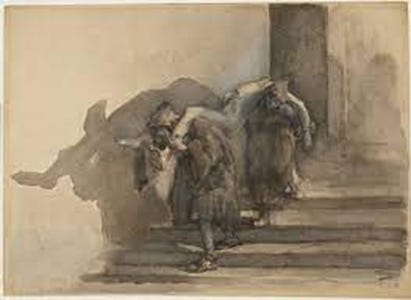
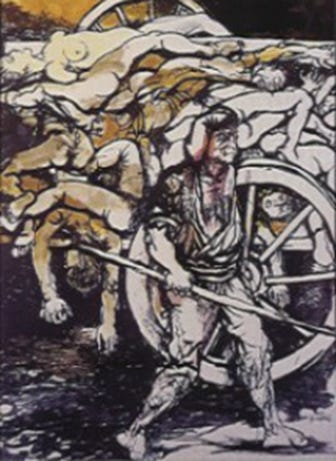
Let me leave you with two images of the dreaded “monatti”:
Previati (ca. 1895-99):
Guttuso (from the 1960 Einaudi edition, with an introduction by Alberto Moravia, who disliked the novel):
Join us on April 10 for a virtual discussion of The Betrothed with Michael F. Moore.
 | A guest post by
|
More of Manzoni's irony when he comments, saying how everyone now "recognising Nevers as the new Duke of Mantua, when the whole purpose of the war had been to keep him out of Italy". A prescient remark that might also be applied to the war in Europe at the moment.
Manzoni's comments on the day of the procession are good...'piety clashing with evil etc'. He finishes with "In truth, it was feeble human intellect clashing with its oiwn delusions.
The more I think about the novel, I am feeling more symathetic towards Don Abbondio. He is 'l'homme moyen sensuel' à la Bloom in Joyce's Ulysses. All these princes and prelates and war lords, and Don A. just wants to live a quiet life. A lot of the powerful characters in the novel remind me of Cesare Pavese's observation when he wrote that all sins have their origin in a sense of inferiority otherwise called ambition.
What we've learned is that in any epoch, a large part of society reacts to a plague the same reprehensible way, and these reactions take on different forms as the plague progresses. The reprehensible reactions are similar regardless of how advanced is medical science. There was even something that resembles QAnon in 1628.
The more I read of this novel, the more I realize that Manzoni, himself born before the nineteenth century, was a man who was very far cited. There are people like him in every epoch, usually writers, like Thomas Paine or Henry David Thoreau or Mark Twain.